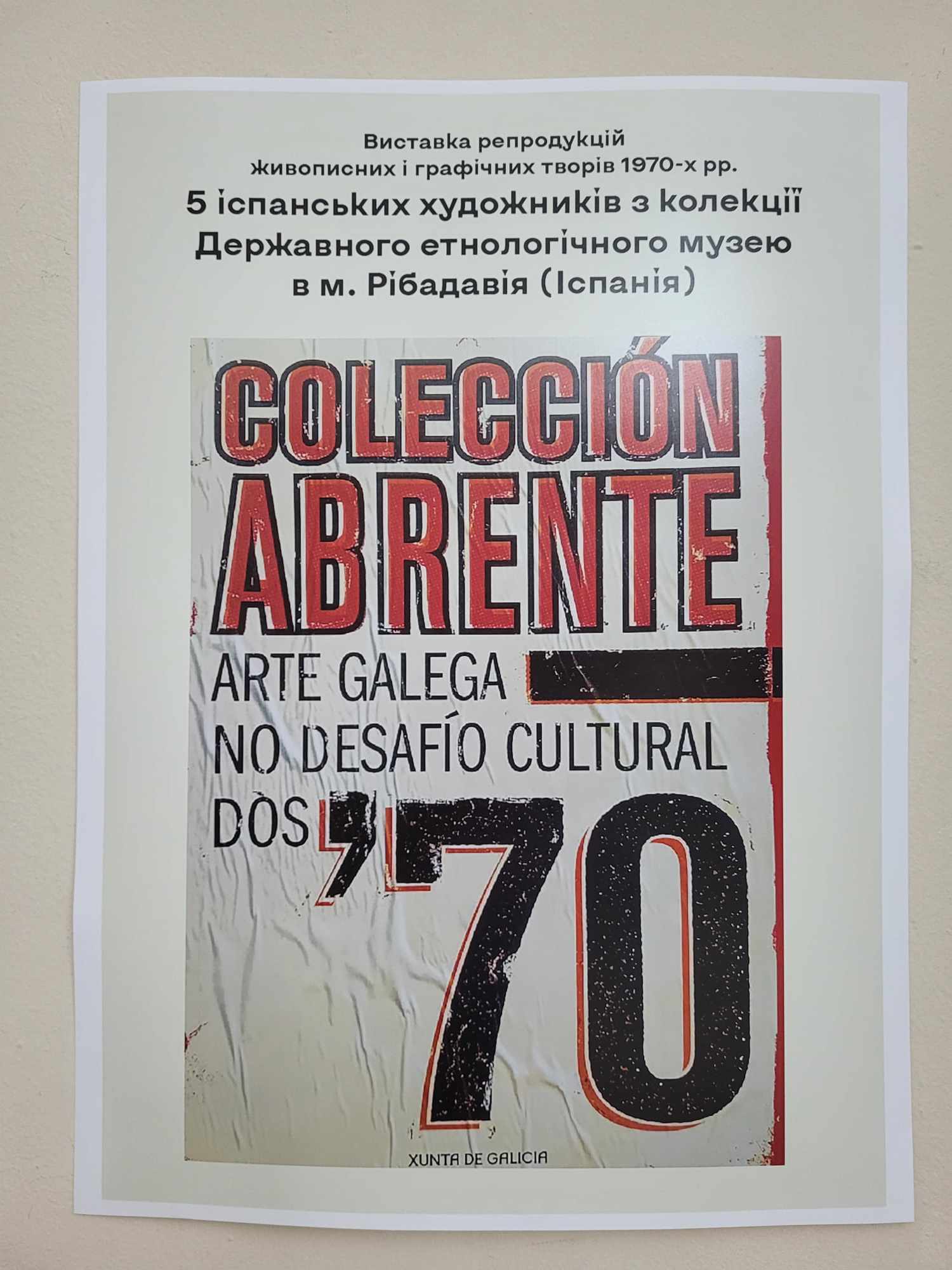
Friends! An exhibition of reproductions of painting and graphic works of the 1970s by five Spanish artists from the collection of MUSEO ETNOLOXICO RIBADAVIA (Spain) has been prepared for the International Day of Museums. This project is a continuation of the cooperation between the National Museum of Decorative Arts of Ukraine and the Spanish Museum.
The exhibition presents 11 works by very different artists, both amateurs and professionals, who have different political views, but equally empathized and collaborated with the Abrente association.
Since the theme of this year’s International Museum Day is “Museums: Education and Research”, we invite our readers to learn more about an interesting phenomenon in the field of culture in Spain in the 1970s, which is connected with the exhibition of works by Spanish artists in the museum.
In April 1939, after the victory in the civil war, the right-wing authoritarian regime of the dictator Francisco Franco was established in Spain. About two million people were subjected to political repression, strict censorship and a ban on opposition parties were introduced in the country.
But later, since 1950, a revival of culture began to take place, especially in the field of theater. On November 8, 1969, the Abrente Cultural Association was founded in the city of Ribadavia, consisting of 7 different sections. The theater section was the most active, one of the goals of which was to popularize the regional language.
Concentrating on a theatrical theme, the Abrente association contributed to a series of performances that began in 1973 and continued until the early 1980s. Their specialty was that at the end of each performance, a debate was held, to which the audience came from all over Galicia, looking for a place where they could express themselves freely.
The Abrente association encouraged collaboration between the country’s artists and writers. The rich and fruitful relationship between intellectuals and artists facilitated their collaboration with the Abrente association in a wide variety of ways, from the creation of posters and theater posters to the transfer of their own artworks for sale to contribute to the financing of the association.
Over the years of its existence, Abrente managed to collect 58 works by 28 artists, all of them Galicians. In 1986, this collection was transferred to the Museum of Folk Art and Costume of Ribadavia, the predecessor of the current Ethnological Museum of Ribadavia.