About the collection
Currently, the collection includes about five thousand works of the 16th–20th centuries.

Wed ‒ Sun: 10:00 ‒ 18:00
Mon-Tues: Closed
About the collection
Currently, the collection includes about five thousand works of the 16th–20th centuries.
Artistic works of wood occupy a proper place in the collection of the National Museum of Decorative Arts of Ukraine.
Today, the collection includes about five thousand works from the 16th to the 20th centuries. The collection makes it possible to determine the national identity of artistic carving in all its diversity of local features, to reveal the diversity of the range of products that differ in purpose, form, and decoration.
The largest groups of museum objects are works from the central part of Ukraine-Kyiv, Poltava, and Chernihiv regions; the western part of Ukraine-Ivano-Frankivsk and Lviv regions; and the northwestern part of Ukraine-Zhytomyr region.
There were many types of artistic carvings in Ukraine: plane, relief, round, and through carvings, but each region had its own specifics.
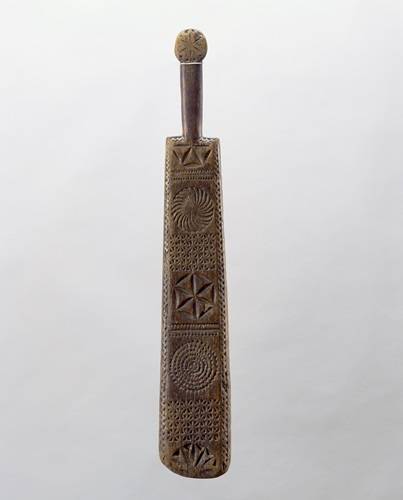
The plane carvings, which are of more ancient origin, are dominated by geometric elements such as rosette, rhombus, circle, cross, etc.
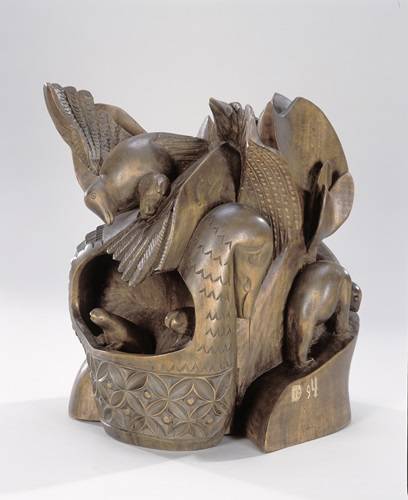
Phyto-, zoo-, and anthropomorphic images were more often depicted in relief and round carving techniques.
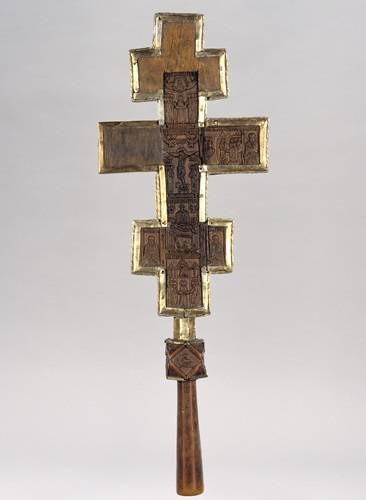
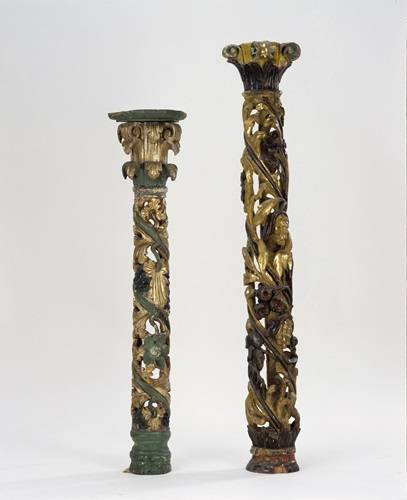
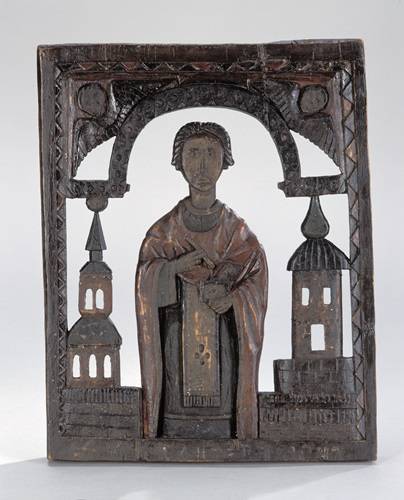
Rare monuments of the collection include a carved cross from 1576 from the village of Ivanychi, Volodymyr-Volynskyi district, Volyn oblast, a sculpture of the Archangel Michael, columns from iconostases, candlesticks, crosses, an icon of St. Panteleimon, and an eighteenth-century workshop box.
The museum has a valuable collection of crosses from the eighteenth and nineteenth centuries. Some of them have the date of manufacture and the author’s name carved on them. For example, one of them was made by the master Fedir Heorhiiev in 1720.
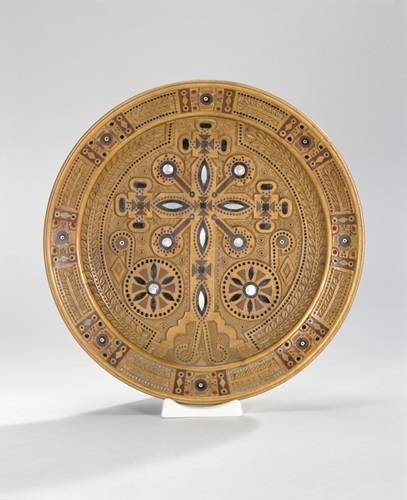
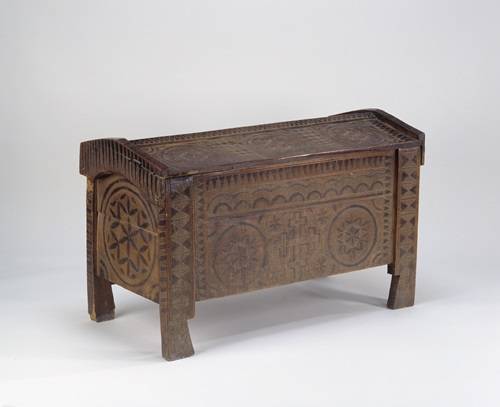
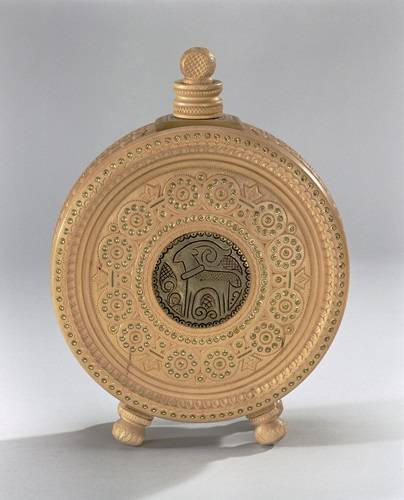
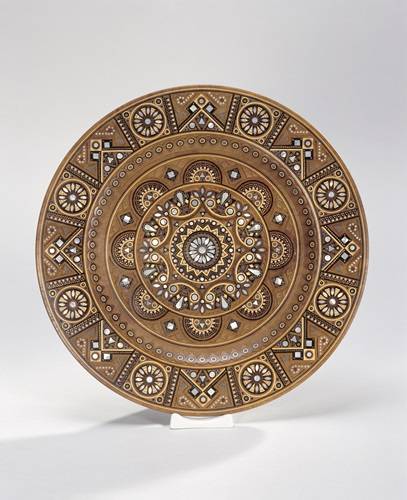
The collection is decorated with works made in the western regions of Ukraine, in particular in the Hutsul region, dating from the second half of the nineteenth and twentieth centuries. Hutsul masters developed their own artistic style: flat “dry” or “clean” carving, which was sometimes combined with other techniques, such as inlay with bone, mother-of-pearl, beads, and metal. Contour carving, or “rituvannya”, was also used to decorate objects. An example is the decoration of Hutsul chests.
The most important contribution to the development of Hutsul carving in the second half of the nineteenth century was made by Yurii Shkribliak, a master from the village of Yavoriv (now Ivano-Frankivsk region). His work became a model for the next generations – the sons and grandsons of the master. The museum’s collection is best represented by the works of Vasyl and Mykola Shkribliak, Yurii and Semen Korpaniuk, and Dmytro Shkribliak.
A new phenomenon in the art of Hutsul carving of the twentieth century was the works made by such leading Kosiv masters as Volodymyr Huz, Vasyl Kabin, Ivan Balahurak and Dmytro Toniuk, and Mykola Kishchuk, who came from the village of Rika.
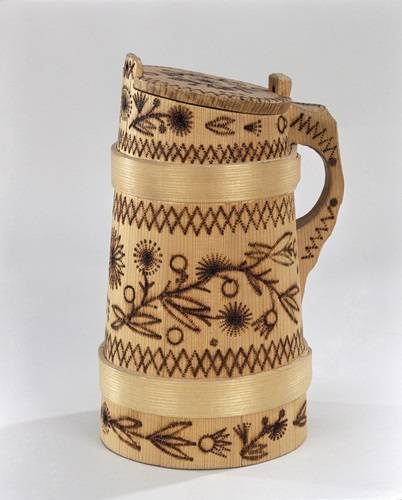
In the Hutsul region, cooperage was made of resinous wood, which was ornamented by burning. Ivan Hrymaliuk from the village of Richka, Ivano-Frankivsk region, was recognized as the best author of such products.
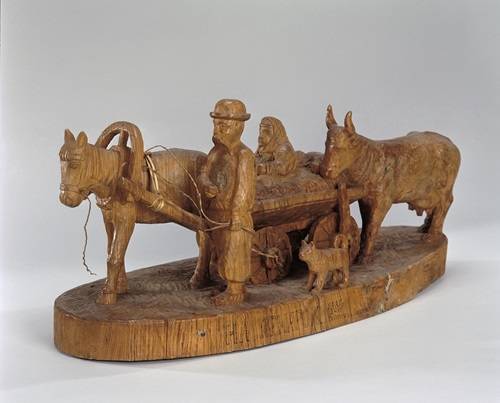
Lemko floral carvings are original. Plates, breadbaskets, etc. were decorated with openwork and relief ornaments consisting of leaves, flowers, and fruits. However, the collection is dominated by small wooden sculptures. The main subjects of plastic compositions are animalistic images and images on everyday and ethnographic themes. The most famous authors of such works are: Pavlo and Vasyl Odrekhivskyi, Andrii and Stepan Orysyk, Antin Figel, Ivan and Stepan Kyshchak, Andrii Sukhorskyi, Yurii and Myron Hambitskyi, Mykhailo Stetsiak, and others.
It is worth noting the talent of the sculptor, People’s Artist of Ukraine Vasyl Svyda from Uzhhorod. His imagination and unsurpassed skill were especially vivid in his multi-figure compositions on themes from the life of the Hutsuls.
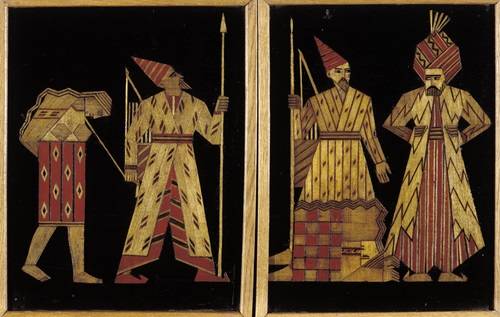
In Polissya, there was a tradition of decorating wood products not only with carvings but also with straw inlay. The People’s Artist of Ukraine Oleksandr Sayenko, originally from Borzna, Chernihiv region, preserved and developed the tradition of this art.
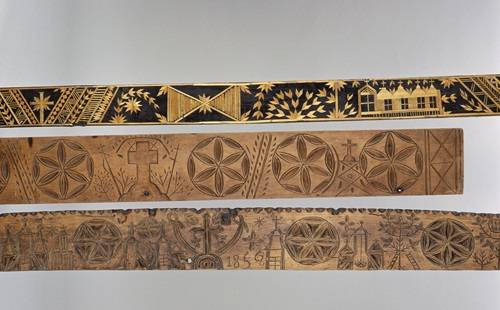
On the Left Bank of Ukraine, i.e. in the Kyiv, Chernihiv, and Poltava regions, flat triangular notched carvings were widespread. Samples of nineteenth- and twentieth-century products with this type of carving are represented in large numbers in the museum’s collection.
A variety of decorations with images of churches and the Calvary cross surrounded by geometric ornaments distinguish the shrines that served as shelves for home icons.
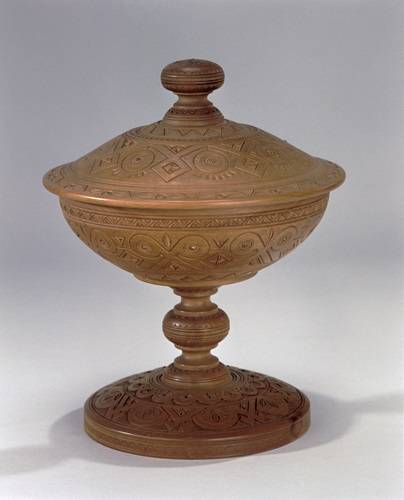
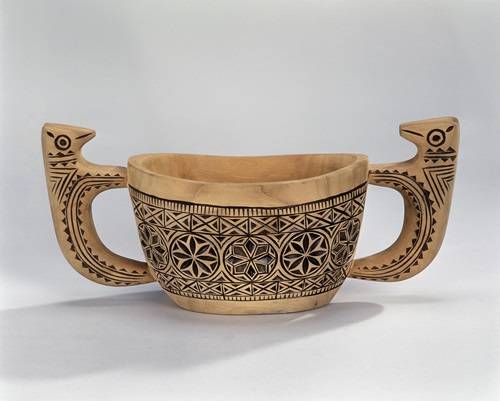
The plasticity of the forms, harmoniously emphasized by the carved decor, is characterized by wooden utensils: saltcellars, koryachki, bowls, spoons, etc., which had not only a domestic purpose but also a ceremonial one.
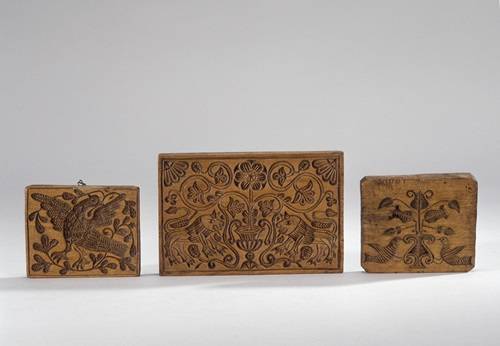
Of particular interest in the museum’s collection are gingerbread molds for gingerbread cookies with carved ornaments embedded in the wood, which were used to make an impression in the dough.
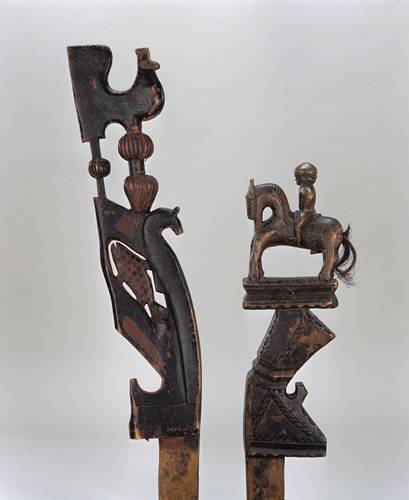
The carvers’ desire to make their products necessary and convenient to use, as well as aesthetically pleasing, is demonstrated in the tools (rubles, washers) and details of vehicles (yokes, arcs, lutes, attachments and backs of sleds and carts).
At the end of the nineteenth century and until the 1940s, the work of Ukrainian folk artists and professional artists was influenced by the Art Nouveau style. At this time, the latest ideas were comprehended and embodied in the spread of new forms and images. Signs of this style can be seen in the works of Vasyl Harbuz from the village of Mali Budyshcha, Poltava region. His talent was especially evident in the creation of various objects decorated with triangularly dimpled carvings.
The echoes of Art Nouveau are clearly and vividly embodied in sculptural compositions that are imbued with an expressive rhythm. It was this kind of sculpture that attracted the talented master of artistic carving Yakiv Halabudnyi from the village of Zhuky in Poltava region.
In the late 60s of the twentieth century, the development of carving in Poltava region was determined by the work of Valentyn Nahnybida and the masters of the Kremenchuk school headed by him, such as Mariia Pereverzyna and Mykola Zatserklianyi.
The Kyiv school is represented by works by masters of plane carving Volodymyr Vynohradskyi and Franz Mozharovskyi; the Chernihiv school is represented by works by Mykola Panko.
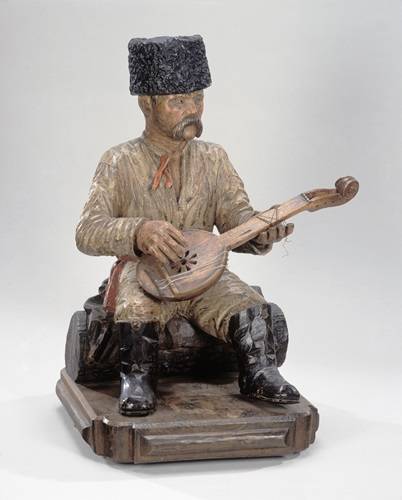
Anton Shtepa from Svarychivka village in Chernihiv region and Mykhailo Miniail from Okhtyrka in Sumy region were recognized as unsurpassed masters of folk sculpture. Among the works of A. Shtepa, compositions on ethnographic themes deserve special attention. M. Miniailo revealed his talent most vividly in works on historical themes. Despite the static figures, violation of proportions, and conventional image, their images impress with their extraordinary integrity and inner expression.
The works of Petro Verna from the village of Hora, now Boryspil district of Kyiv region, are considered classics of folk sculpture. The master was especially interested in literary themes. His favorite writers were Taras Shevchenko, I. Kotliarevskyi, and N. Hohol. The talented carver created a portrait gallery and plot compositions based on the works of these authors.
Vasyl Zavhorodnii from Kyiv is an original master of sculptural wood carvings. He was especially fascinated by the subjects from the history of the Cossacks.
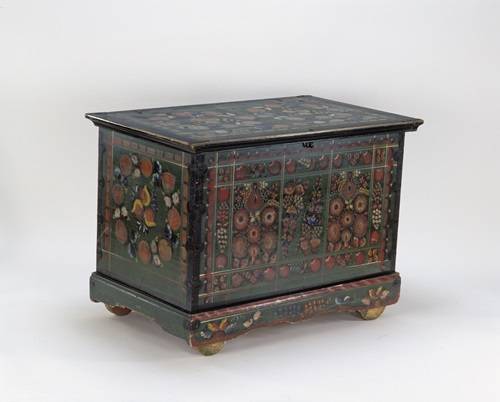
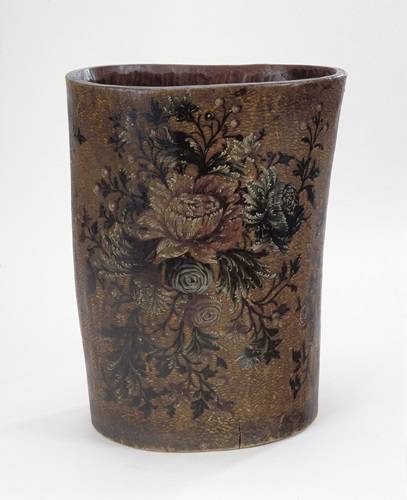
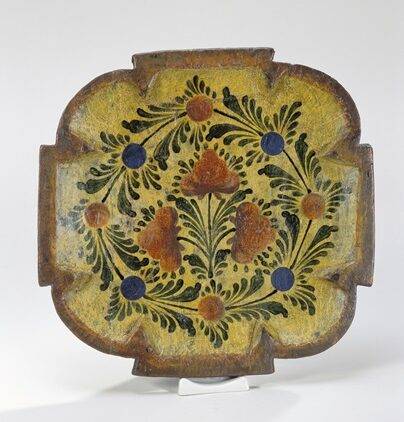
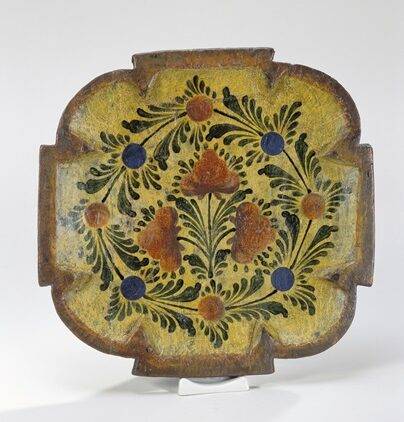
Works decorated with paintings constitute a small but very valuable group of museum objects that give an idea of the spread of this method of decorating wood products.
This group includes painted wedding chests, bowls, cabinets, shelves, and utensils of the eighteenth and nineteenth centuries, which were an integral part of peasant interiors until almost the middle of the twentieth century in Kyiv, Chernihiv, Poltava, Katerynoslav, and Podillia.
Chests occupied a special place in the house. They had not only a practical purpose (dowry was kept in them), but also an artistic and decorative, ritual and ceremonial function.
A large group of works includes dishes decorated with paintings: bowls, plates, trays with floral ornaments. Some items feature human images or still lifes of vegetables and fish, successfully arranged in round or cross-shaped objects.
The best wooden monuments that have survived to this day testify to the harmony of expediency and beauty. The carvers sought to achieve perfection and plasticity of the objects’ shapes, as well as perfection and uniqueness of the decor.
Selected works